
StimPad: Exploring Auditory Stimming Through Sound
Inspired by his own son's love of sounds, independent developer Brock Hall created StimPad, an app that brings together 95 familiar noises in one easy-to-use place. With a wide variety of sounds to explore, it offers a simple way to find and enjoy personal favourites, whether at home, during learning or on the go.
Oct 14
Summary
Stimming, short for self-stimulatory behaviour, describes repetitive actions or behaviours that people engage in for a variety of reasons. These might include rocking, hand-flapping, tapping, humming or repeating certain sounds.
The pop of bubble wrap, the click of a pen or the gentle hum of a fan. These everyday sounds might not seem like anything special, but for some people, they can be comforting, enjoyable or simply satisfying to listen to. This is particularly true for those who enjoy auditory stimming, where listening to or repeating certain sounds can be a way to relax, focus or enjoy a sensory experience.
Inspired by his own son’s love of sounds, independent developer Brock Hall created StimPad, an app that brings together 95 familiar noises in one easy-to-use place. With a wide variety of sounds to explore, it offers a simple way to find and enjoy personal favourites, whether at home, during learning or on the go.
What Is Auditory Stimming?
Stimming, short for self-stimulatory behaviour, describes repetitive actions or behaviours that people engage in for a variety of reasons. These might include rocking, hand-flapping, tapping, humming or repeating certain sounds.
Stimming is particularly common among autistic and other neurodivergent individuals, although it’s something we all do to some extent. Think about tapping your foot to music or absent-mindedly clicking a pen while concentrating.
For some children and young people, stimming can help them manage emotions, process sensory information or feel more comfortable in their surroundings. For others, it’s simply something they enjoy.
Auditory stimming specifically involves listening to, making or repeating sounds. This could be anything from the sound of running water to the clicking of a keyboard or the hum of a household appliance.
Of course, sensory preferences vary enormously. A sound that one child finds comforting might be overwhelming for another, which is why having the freedom to choose is so important.
Meet StimPad
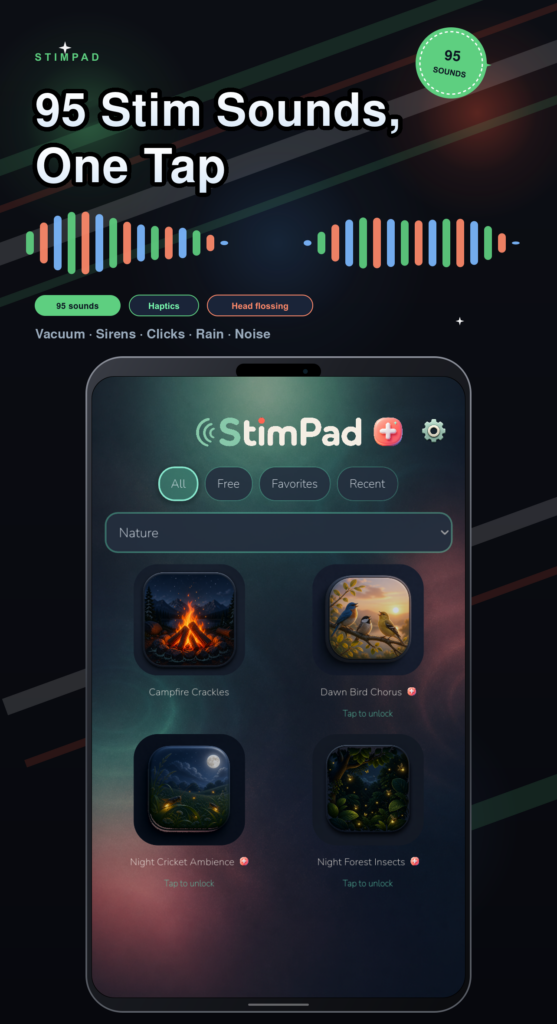
StimPad brings together 95 different sounds in one easy-to-use app for iPhone and iPad.
The sounds range from familiar household noises, such as vacuum cleaners and hair dryers, to nature sounds, bubble wrap, pen clicks, fans and white noise. There are also different types of background noise, including white noise (a steady hissing sound), pink noise (a softer, more balanced sound) and brown noise (a deeper, low rumbling sound).
Everything is organised into 12 categories, making it easy to explore and find favourites.
One of the app’s main features is its simplicity. Rather than having to navigate multiple screens or complicated settings, users can tap a large button to play a sound and choose to loop it for as long as they like.
There’s also the option to save favourite sounds, so children can quickly return to the ones they enjoy most.
And because the app works offline, it can be used without an internet connection. This could be particularly handy when travelling or taking a sensory break away from home.
StimPad includes 14 sounds for free, while an optional one-time purchase of StimPad Plus unlocks all 95 sounds and removes advertisements.

The Story Behind StimPad
Sometimes the simplest ideas come from personal experience, and that’s certainly the case with StimPad.
The app began with Brock’s son, who regularly enjoys stimming to different sounds. It was actually his son’s idea to bring those sounds together in an app, and Brock decided to make it happen.
We spoke to Brock about what inspired him to create StimPad and what he hopes other families might get from it.
“StimPad started with my son. He loves stimming to sounds and does it all the time, and it was actually his idea to put those sounds into an app. So I built it for him and went looking for sounds he would enjoy, and that I hoped other children and young people would enjoy too. My hope is that StimPad gives children an easy, predictable way to reach the sounds they love whenever they need them, whether that’s at home, in a lesson or during a sensory break, and that it becomes a simple stimming resource families and tutors can lean on.”
– Brock Hall, Creator of StimPad
It’s a lovely example of how listening to a child’s interests and experiences can inspire something that other families may find useful too.
Rather than trying to change or discourage stimming, StimPad embraces it, giving children an easy way to enjoy the sounds they naturally gravitate towards.
Could StimPad Be Useful During Learning?
Every child has different sensory needs, and what works well for one learner won’t necessarily work for another.
For children who enjoy auditory stimming, having access to familiar sounds could be a useful addition to their everyday routines, including during tutoring sessions.
For example, a child might enjoy listening to a favourite sound during a short break between activities. Others may like having the option to choose a familiar noise when moving between tasks or settling into a new environment.
The app’s favourites feature could also be useful for children who have particular sounds they return to regularly, without having to search for them each time.
There’s an element of independence here, too. Being able to choose a sound, play it and stop it themselves gives children greater control over their own sensory experiences.
For parents and educators, StimPad could also be an interesting way to explore a child’s sound preferences together. You might discover that they particularly enjoy rhythmic clicking sounds, for example, or that they prefer the steady background noise of a fan.
That said, it’s important to follow the child’s lead. Some children are particularly sensitive to noise, and even familiar sounds can become overwhelming depending on the environment, volume or how they’re feeling that day.
It’s also worth remembering that StimPad is designed as a sensory sound toy, rather than a medical or therapeutic tool. Its purpose is to make enjoyable sounds accessible, not to replace individualised sensory support or professional advice.
Making Space for Different Sensory Preferences
At SEND Tutoring, we understand that creating a positive learning experience involves more than finding the right academic resources. It’s also about recognising what helps each child feel comfortable, engaged and ready to learn.
For some learners, that might mean movement breaks, fidget toys or a quieter learning space. For others, familiar sounds might be something they enjoy having available.
There isn’t a one-size-fits-all approach to sensory needs, and that’s why it’s always interesting to discover resources that offer children more choice.
StimPad is a relatively simple concept, but that’s part of its appeal. It focuses on making a wide range of sounds easy to find, play and enjoy, and perhaps the nicest part is where it all started: with a child sharing something he loved and a parent taking that idea seriously.
Where Can You Find StimPad?
StimPad is available to download on iPhone and iPad through the Apple App Store.
You can try 14 sounds for free, with the option to unlock the full collection of 95 sounds through a one-time StimPad Plus purchase.
Explore StimPad on the App Store
We’re always pleased to hear about new resources and ideas that could be of interest to the SEND community, particularly those inspired by the experiences of children and families themselves.

Support for Every Learner
Discover how SEND Tutoring supports students with a wide range of needs, including autism, ADHD, dyslexia, PDA, SEMH, epilepsy, and more.
Resources and Insights
Stay Connected
Follow us on social media for updates, tips, and stories from our SEND community.
About the author
Ella Jones
If you’re looking for support for a child or young person with special educational needs or a disability, book a free call with us today and find out how we can help.

Share this
Podcast, blog and more
More news and resources from SEND Tutoring

Support
Nov 04
21 Min Read
“Inclusion Has to Be Held in People’s Hearts, Not Just Written in Policy”
Parents and carers are often asked to contribute to discussions about SEND provision through surveys, consultations and meetings. Yet being invited to share an opinion does not necessarily mean having influence over the decisions that follow.

SEN Stories
Oct 30
13 Min Read
Finding Work That Works: A Career Guide for Parents of Children with SEND
Finding a job is one thing. Finding one that fits around the realities of raising a child with special educational needs and disabilities (SEND) is another.

Media
Oct 29
2 Min Read
SEND Tutoring Named Finalist at the Stars of Learning Disabilities & Autism Awards 2026
We’re excited to be recognised alongside other inspiring individuals and organisations working to improve support and opportunities for autistic people and those with learning disabilities.